

The tools aren’t the magic. You are.
I recently listened to an episode of The Artificial Intelligence Show Podcast, and one thing really stuck with me:
These tools are most powerful when they complement someone who is already an expert in their domain.
And it made me think about everything we’re trying to manage in our lives.
Because whether you’re a parent, a leader, a subject matter expert, a caregiver, a volunteer, or a youth sports coach…
you are the expert in your domain.
And because of that, something subtle—but important—starts to happen.
We don’t just use tools.
We become the tool.
The person everyone goes to.
The one who can figure it out.
The one who gets things done.
This is often how responsibility quietly builds over time – something I wrote more about in When Responsibility Creeps.
I once had a CEO tell me:
“If you want something done, give it to a busy person.”
(That quote is often attributed to Benjamin Franklin.)
And I’m sure you can imagine how that makes a busy person feel.
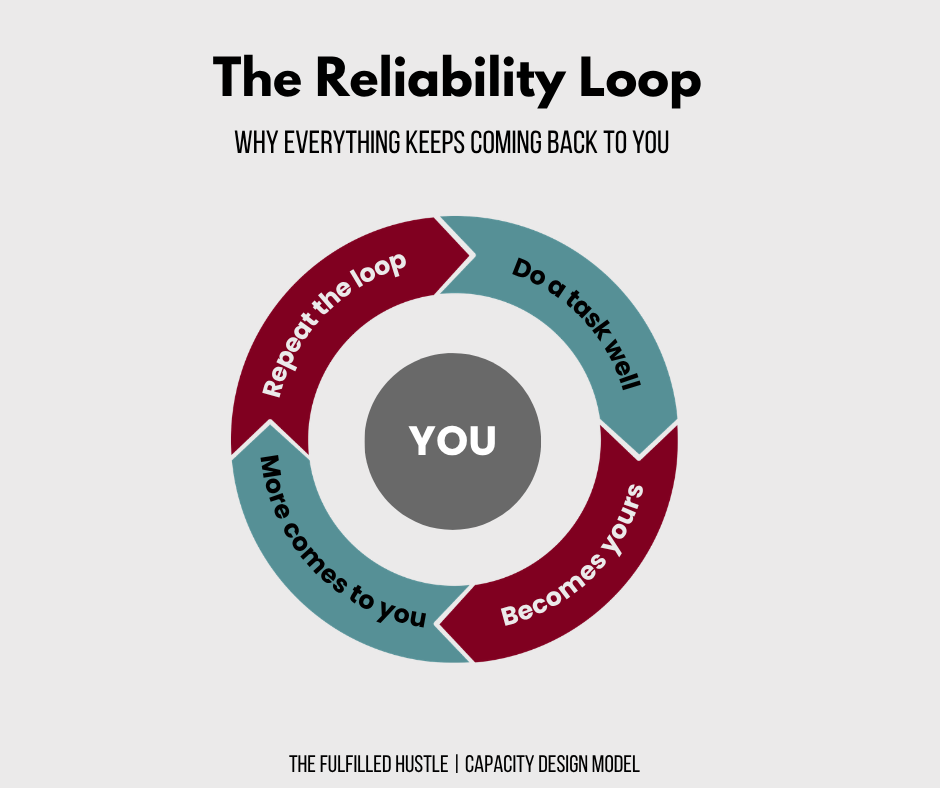
If you’re always the one everyone relies on – at work or at home – you may be stuck in what I call the Reliability Loop.
How the Loop Starts
But think about it.
Someone comes to you and asks you to do something—or you just step in and do it naturally.
And you do it really, really well.
You plan the trip.
Everything is scheduled.
Everything is booked.
Everything is confirmed.
The bags are packed.
The tickets are bought.
So what do you think happens the next time a trip comes up?
That’s right.
Everyone comes right back to you.
Because you did such an amazing job.
And it feels good.
Most of us want to be good at what we do.
We want to help others.
We want to show up.
We want to be the one people can count on.
But this is where something subtle starts to happen.
This is what I call the Reliability Loop.
What the Reliability Loop Really Is
The Reliability Loop is a self-reinforcing pattern where responsibility continuously flows back to the most reliable person—because they’ve proven they can handle it.
We don’t fall into this loop because we’re doing something wrong.
We fall into it because:
- We’re capable
- We care
- We follow through
- We reduce friction for everyone else
And over time, systems—at work and at home—naturally optimize around that.
It closely connects to what I describe as responsibility creep – where more and more starts to route to you simply because you’ve proven you can handle it.
When It Becomes Too Much
And once you’re in the Reliability Loop…
You don’t just go around once.
You go around again.
And again.
And again.
But it’s not just about the trip.
It’s everything.
Everything you do well.
Everything people can count on you for.
Everything that’s easier to send your way than to figure out another path.
Until suddenly, you’re spinning.
Trying to keep up with all of it.
Holding all of it together.
You become a human tornado.
And over time, that creates a kind of invisible load – where you’re not just doing the work, you’re holding all of it mentally, too.
Where Capacity Design Comes In
And this is where we put Capacity Design into the mix.
Capacity Design is the intentional redesign of how responsibility flows – so it doesn’t automatically come back to you every time.
It’s stepping back and asking:
- Where am I stuck in the Reliability Loop?
- Where are decisions routing straight to me by default?
- What levers can I pull to change that flow?
Because this isn’t about becoming less reliable.
It doesn’t mean you’re not capable.
It doesn’t mean you stop being the expert in your domain.
It means something different.
It means you stop being the only place everything works.
And instead…
You start using the tools you already have—
not just to keep up with the work…
but to manage how the work moves.
Off your plate.
Out of your head.
Through systems that don’t depend entirely on you.
Creating space.
In your brain.
In your time.
In your life.
You’re Not the Problem
If this feels familiar…
You’re probably not the problem.
You’re just stuck in the loop.
A Quiet Next Step
If you’re starting to see where everything routes back to you, that’s usually the first signal.
It’s also why I started writing more about this in Work on Purpose – because this isn’t just about productivity, it’s about how your work and life are actually structured.
Capacity Design is about changing that flow—quietly, intentionally, and in a way that actually holds.
If you want a structured way to look at your own loop, that’s exactly what I do inside a Capacity Audit.
It’s a simple way to map where things are looping back to you – and identify a few targeted shifts that can create immediate relief.
And if this resonated…
I’d love to hear where you’re seeing it show up.
R
Related Reads: