

Do you ever stop and look at everything that needs to be done…
…and think: I just need to do better…work harder…find the system that finally works...
But the problem isn’t how you’re managing your time.
It’s how responsibility is flowing to you in the first place.
The Reality of Responsibility
We all start with a baseline.
- your job
- basic life responsibilities
- taking care of yourself
- the day-to-day things that just need to get done
But over time, life expands.
Your role grows.
Your responsibilities evolve.
Your world gets more complex.
You move:
- from a job to a career
- from individual contributor to leader
- from single to partnered to parenting
- from being cared for… to becoming the caregiver
And as all of that grows…
you don’t suddenly get more time.
How It Builds
This is where it starts.
Responsibility creeps.
Things get added—slowly, almost invisibly. Then the pressure builds.
You’re still handling it. Still performing. Still showing up. But it starts to feel heavier.
That’s Capacity Compression.
And because you care—and because you’re capable—you continue to perform under that pressure.
You do things well. So, they become yours. More comes to you. And it repeats.
That’s the Reliability Loop.
This Isn’t Random
These aren’t separate problems.
They’re stages of the same pattern.
- Things get added
- Pressure builds
- Work cycles back to you
Until everything depends on you to keep it moving.
The Way Out
At some point, you start telling yourself:
I just need to do better.
Work harder.
Figure out the right system.
But that’s not the way out.
The way out is to redesign the system itself.
What Is Capacity Design?
This is what I call the Capacity Design Model.
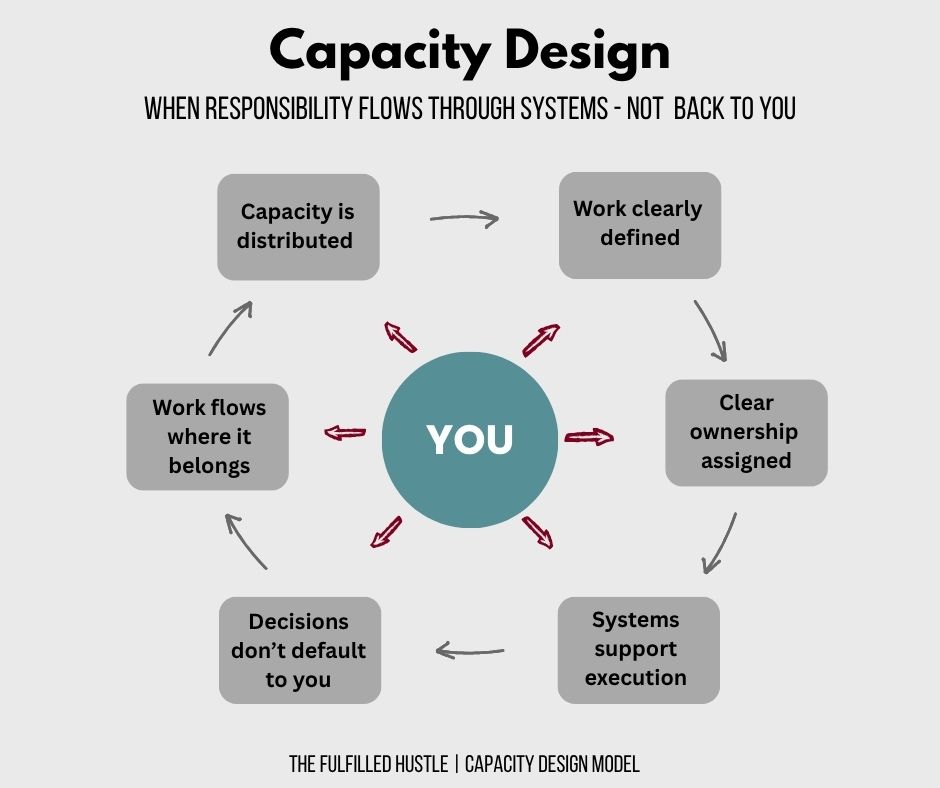
Capacity Design is the intentional redesign of how responsibility flows through work and life so that everything doesn’t depend on one person to keep it moving.
The Shift
Once you see the pattern, you have a choice:
- Continue operating inside the loop
- Or redesign how everything flows
Most people try to manage the outcome.
Capacity Design changes the structure.
Why Most Solutions Don’t Work
This isn’t about tools.
I love a good calendar.
A great system.
Even the latest AI tools.
But:
- Time management doesn’t create more time
- Delegation doesn’t stop things from routing to you first
- Productivity tools don’t change ownership
They help—but they don’t fix the core issue.
Because the issue isn’t execution.
It’s flow.
The Reality
Speaking from experience:
You can’t optimize your way out of a structure that keeps routing everything back to you.
What Capacity Design Actually Does
Capacity Design focuses on four key shifts:
- Decision flow – fewer decisions defaulting to you
- Ownership clarity – what’s actually yours vs. what just became yours
- System support – structure that carries the work
- Reduced dependency – things don’t require you to keep moving
What Changes
The work doesn’t disappear.
But instead of everything depending on you:
- ownership becomes clear
- fewer decisions route back to you
- systems start doing the work
- you have space to think again
You’re still reliable.
Things are still getting done.
But you’re no longer the system.
Where to Start
If you’re reading this and thinking, this is exactly what’s happening…
You’re not alone.
And you don’t have to keep operating this way.
This is exactly what we map and redesign in a Capacity Audit.
If this feels familiar, it’s not a personal failure—it’s a structural pattern.
I work with high-capacity professionals and parents to map where responsibility is accumulating and redesign how it flows—so everything doesn’t depend on them to keep it moving.
You can learn more about the Capacity Audit here: Capacity Audit | A Better Way to Carry Work and Life