

There’s a moment most high-capacity people recognize.
You’re keeping up.
You’re handling things.
You’re doing what needs to be done.
And yet… you feel behind.
Not because you’re failing.
But because everything feels heavier than it should.
That feeling has a name.
Capacity Compression.
What is Capacity Compression?
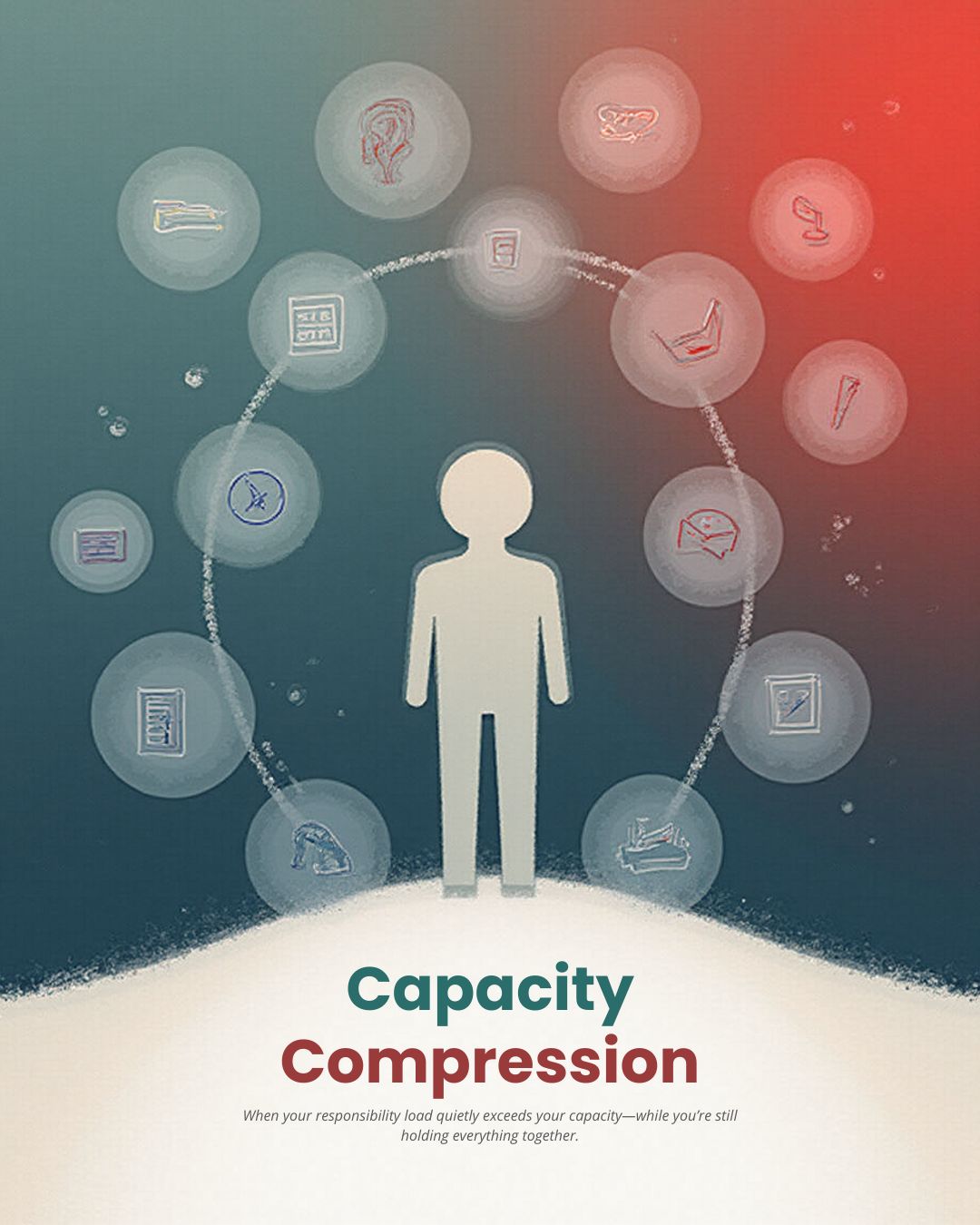
Capacity Compression is what happens when your responsibility load quietly exceeds your available capacity—without anything visibly breaking.
You’re still functioning.
Still delivering.
Still showing up.
But internally, everything is tighter, heavier, and harder to hold.
It’s not burnout.
It’s not laziness.
It’s not a time management issue.
It’s structural.
What It Actually Feels Like
Capacity Compression doesn’t show up as failure. It shows up as friction.
- You’re constantly thinking about what you might be forgetting
- Small decisions feel disproportionately draining
- You move from one responsibility to the next without breathing room
- Your brain never fully “closes the loop” on anything
- Even when things are going well… it still feels like a lot
You don’t crash.
You just… compress.
Where This Starts for Most People
For many people, this starts with something subtle—what I call responsibility creep.
Small things get added.
You pick things up because it’s easier.
People start coming to you because you’re reliable.
Until suddenly… you’re carrying far more than you realized.
If that sounds familiar, you can read more about it here:
→When Responsibility Creeps Past Your Boundaries – The Fulfilled Hustle
Why High-Capacity People Experience This First
If you’re the person who:
- figures things out
- keeps things moving
- fills in gaps without being asked
Then you are naturally positioned to absorb more.
Because you’re reliable.
And over time, reliability becomes a magnet.
Why Time Management Doesn’t Fix This
Most advice tells you to:
- prioritize better
- wake up earlier
- optimize your schedule
But this isn’t a time problem.
It’s a responsibility flow problem.
The Real Risk
If Capacity Compression continues long enough, it starts to organize itself into a pattern.
Work begins to flow toward the most reliable person—again and again—until everything cycles back to them.
Not because anyone designed it that way.
Because it works.
Over time, this becomes a self-reinforcing loop.
I call this the Reliability Loop.
What to Do First
Start by noticing:
- Where do decisions always route to you?
- What are you holding in your head instead of in a system?
- What do people default to you for?
This Isn’t About Doing Less
It’s about designing differently.
There’s a way to structure work and life so that:
- responsibility doesn’t bottleneck around one person
- decisions don’t require constant oversight
This is one of the core patterns I see within what I call Capacity Design.
If this feels familiar, it’s not a personal failure—it’s a structural pattern.
Email me at rachel@thefulfilledhustle.com for more tools for high-capacity professionals and parents that help you map where responsibility is accumulating and redesign how it flows—so everything doesn’t depend on them to keep it moving.
R
2 Replies to “Capacity Compression: The Hidden Reason You Feel Constantly Behind”
Comments are closed.